Home
Factbook
Geography
History
People
Symbols
Government
Defense
Diplomacy
Economy
Contact
Tech Area
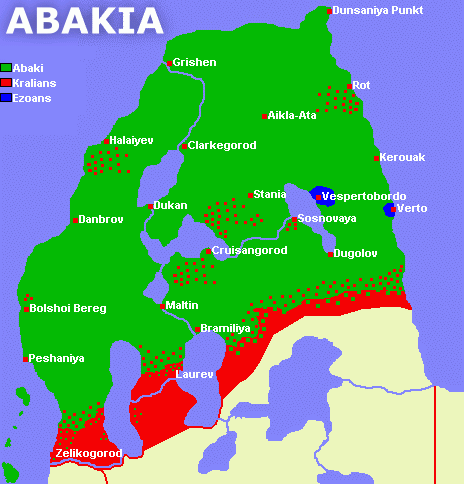
PeopleThe people of Abaki can be divided, basically, in three ethnic groups: Abaki, Kralians and Ezoans. The Abaki make up the majority of the population of Abakia, being the descendents of the original Kzanikhi settlers who arrived in our territory by 1600 BP.
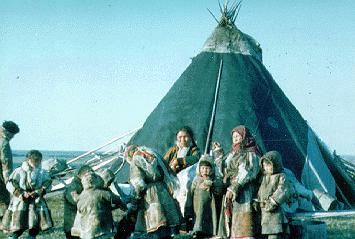
Some Abaki are still nomadic farmers. This picture shows a group of reindeer herders. Note the typical clothing.The Kralians (also known as Ulanogronkians) are the descendents of the many different waves of invaders, plus some groups who were settled on the Red Sky Lakes. They can be further divided in Ulanovans, Gronkians, Goltonians, Zartanians and Lysonians. They are the majority on the southern areas of the country, arround lakes Arial and Montilliya.
Actually, nobody can really talk of "pure" Abaki or Kralians. Most of the population of the Abaki Soviet is made up of half-blooded Abaki-Kralians, thanks to centuries of miscigenation. However, most of these Abaki-Kralians consider themselves Abaki, due to their culture and facial features.
The Ezoans constitute the smaller ethnic group in Abakia, being the small groups of settlers brought in by the invading Kingdom of Elaphites and Zuphites in mid-301.
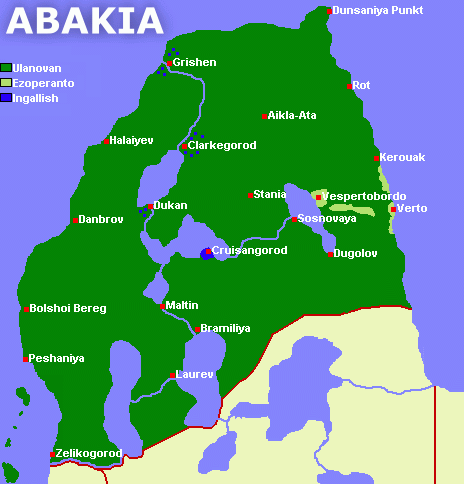
Ethnographic map of the Abaki Soviet.The most widely spoken language in Abakia is Ulanovan, brought in by the Kralian invaders and written with the Ulanovan [ TECH: Cyrillic ] script. It has been the official language of the region for the last twelve centuries. Little to no trace is left of the original Kzanikhi language spoken by the first Abaki, except for some placenames, like Dukan, Rot or Aikla-Ata.
Ingallish is also spoken by some small groups, mostly arround the city of Cruisangorod. It was the language of some ethnic-Kralians who settled arround lakes Arial and Montilliya on the 8th century BP. Thanks to intense trading with Cruisana, and also due to Ingallish being the working language of their Church, it didn't disappeared. However, Abaki Ingallish is strongly influenced by Ulanovan, and is also written with a mixed Liliance-Ulanovan alphabet. See the sample below:
Віььу тніѕ уоvиg ьевотснка, Бояіѕ.
Viddy this young devotchka, Boris
See this young lady, Boris.Ezoperanto is spoken only by the recent Ezoan settlers.
Languages of Abakia.